ERP
- SAP
- IFS
- Logo
- Netsis
- Canias

Agents that compare demand, stock, capacity and open orders, list what will run short or late, and prepare the forecast and the plan review. The planner decides.
Agents already doing real work.
less manual reporting effort

Agents at work in enterprise teams


Every morning the agent reads orders, stock and capacity from your systems and lists what needs a decision: the item that runs short, the line that is over, the delivery that cannot be met. Live in four weeks.

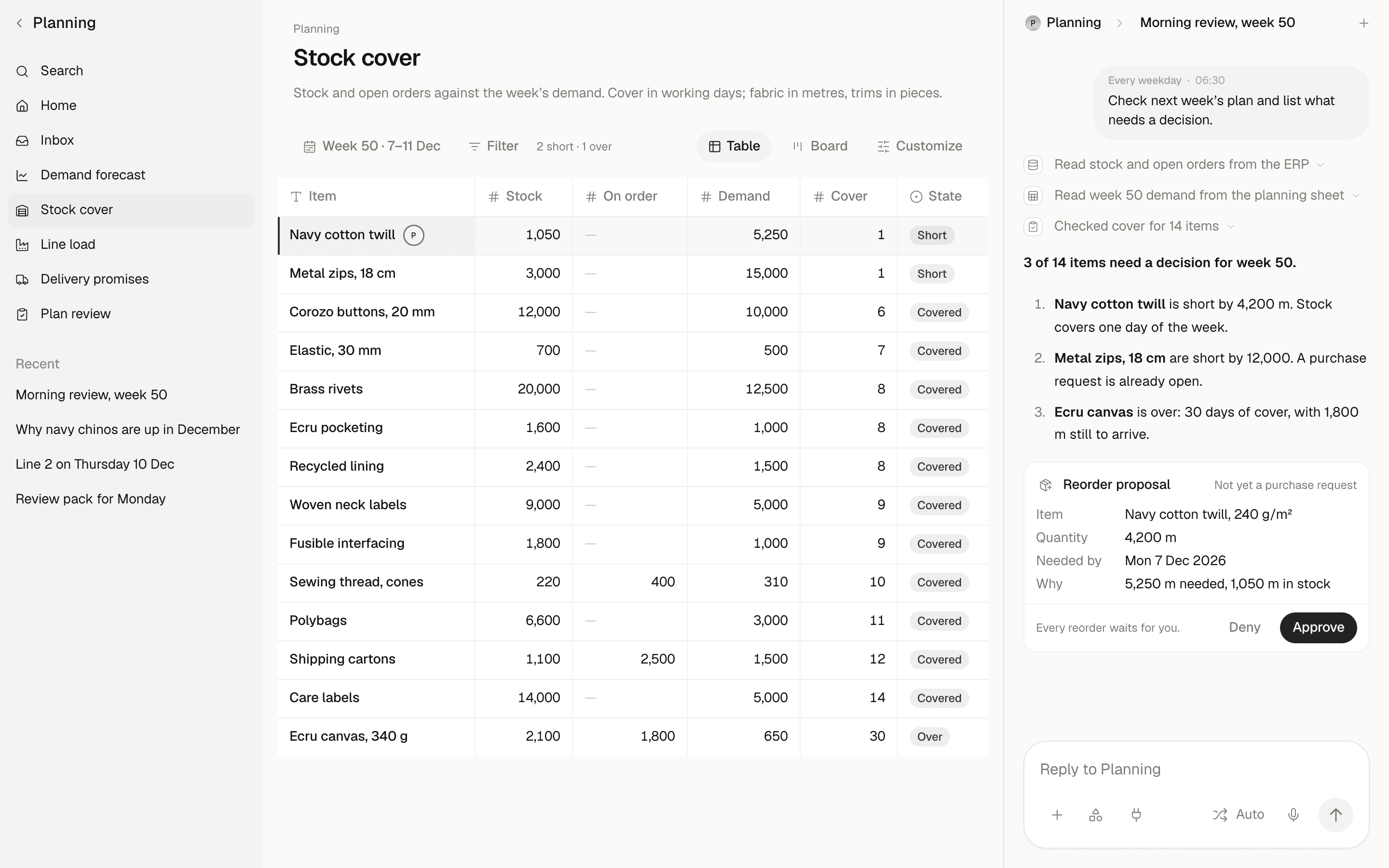
One agent checking every item, every day.

Demand
The agent builds the demand forecast from your order history, shows how far off it was last period and explains what changed. You adjust it; it remembers why.

Stock and supply
Stock cover for every item against demand and open purchase orders, with a reorder proposal for each one that will run short.

Production
Each new order and each change is checked against line capacity and materials. When a date cannot be met, the planner hears first.
The parts of the planning agent. It proposes; the planner decides.
A forecast per item from your own history, with last period’s error beside it.
Order history · Seasonality · Forecast error
Days of cover per item against demand and open orders, shortages first.
Cover · Reorder proposals · Open orders
Load per line and week against capacity, with the orders that do not fit.
Line load · Materials · Overloads
Checked against stock, capacity and supply
| Order | Promised | Check | Reason |
|---|---|---|---|
Halvorsen 20431 | 11 Dec | At risk | Line 2 over |
Brandt 20425 | 15 Dec | At risk | Twill short |
Okafor 20422 | 9 Dec | On time | Covered |
Lindqvist 20418 | 18 Dec | On time | Covered |
Every promised date checked against stock, capacity and supply; the ones at risk listed with the reason.
Promise check · At-risk orders · Customer notice
The weekly review prepared for the meeting: demand, supply, stock and the decisions needed.
Weekly pack · Scenarios · Decisions
Each is a named workflow with an owner and a target, not a general assistant. We fit it to your ERP, your planning sheets and your rules.
Demand planning
Every week the agent rebuilds the forecast for each item from your order history and puts last week’s forecast beside what was sold. The items that moved most come first, each with what changed. The planner adjusts a figure and gives the reason; the agent keeps both.
Inventory
Every morning the agent works out the days of cover for each item from stock, demand and open purchase orders. For each item that will run short it drafts a reorder with the quantity and the date it is needed. A reorder becomes a purchase request only when the planner approves it.
Order desk
When an order or a change arrives, the agent checks the requested date against stock, open purchase orders and line capacity. It gives the date that can be met, and the reason when the requested one cannot. The promise to the customer stays with your team.
Production planning
Each morning the agent compares the schedule with capacity, materials and yesterday’s output. It lists the lines that are over, the orders waiting on material and the jobs running late, each with its cause. The planner changes the schedule; the agent does not.
Supply chain
Before the review the agent assembles the pack: demand against forecast, supply, stock cover, capacity and the decisions that are open, each figure with its source. A scenario the meeting asks for is worked out from the same data. The meeting decides.
Maintenance
The agent reads stoppages from your line and fault records, groups them by line, cause and duration and sets them beside the maintenance that was planned. The planner sees which lines lost hours before next week’s schedule is set.
No new planning system and no change to your ERP. The agent reads your ERP, your production data and the sheets you plan in, in our cloud, yours or on-premise.
Our engineers work inside your environment until the first workflow is live, then hand it to your team.
Every figure names the system it came from, every proposal waits for a person, and nothing is written to your ERP without approval. Hosted in our cloud, yours or on-premise.
Encryption at rest, for databases, files and stored credentials
Encryption in transit, HTTPS on every connection
Hosted where you choose: our cloud, yours, or fully on-premise

Sales, data and customer-experience agents, from exploration to voice
Workspaces · Case study
It builds a forecast per item with standard statistical methods on your own history and shows its error. If you have a forecasting model, it uses that.
Next step
Pick one product family. See its demand, stock and capacity checked every morning on your own data in four weeks.